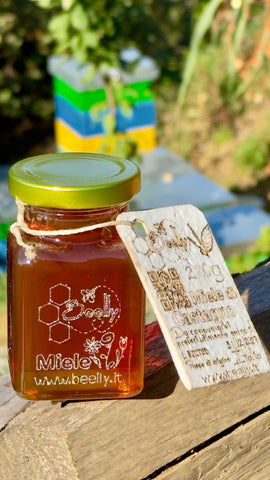






Acacia Honey 230 g – 2026 Harvest
The most delicate part of spring.
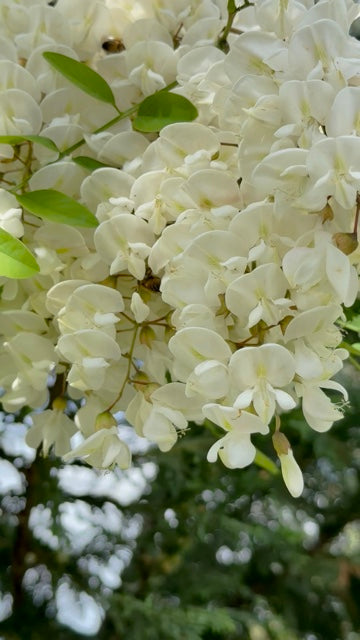
Clear, limpid, and naturally delicate, our Acacia Honey – 2026 Harvest comes from the brief flowering of the Black Locust (Robinia) on the hills of Celle Ligure. Pollen analysis identifies the sample as monofloral Black Locust (Acacia) honey.
| Type | Acacia Honey |
| Botanical origin | Black Locust (Acacia) – 39%* |
| Profile | Fine, delicate, sweet and slightly aromatic |
| Origin | Celle Ligure · Liguria · Italy |
| Harvest | 2026 · small batch |
| Year's production | 180 jars of 230 g |
*Percentage refers to the nectar-producing species identified in the pollen analysis of the tested sample.
Read the complete 2026 Harvest profile ↓
The most delicate part of spring
The Acacia bloom lasts for a short time. It is one of those moments in spring when it only takes a few days for the landscape and the bees' work to change completely.
From this brief window comes our Acacia Honey – 2026 Harvest: clear, limpid, sweet, and characterized by a fine, non-invasive aroma.
Pollen analysis of the sample identifies this harvest as monofloral Black Locust (Acacia) honey, with Black Locust accounting for 39% of the nectar-producing species detected.
Delicate by nature
A honey that accompanies without overpowering: sweet, fine, and delicate.
The 2026 Harvest expresses a discreet aromatic profile: the scent is fine and delicate, the aroma is warm, slightly aromatic and spiced, while the persistence remains short.
It is precisely this delicacy that makes it one of the most versatile honeys in our collection.
A harvest from the Ligurian hills
Celle Ligure · Liguria · Italy
Our bees forage during the brief spring blooming of the Black Locust on the hills of Celle Ligure, in a coastal and woodland-edge territory rich in wild flowers.
Pollen analysis indeed detects, alongside the Black Locust, pollen from Heather, maple, willow, blackberry, rosemary, chestnut, and other local species.
How to pair it
Its fine and delicate taste accompanies foods without covering their flavors.
Cheeses: ricotta, fresh goat cheese, and fresh or lightly aged cheeses.
Breakfast: plain yogurt, toast, fresh fruit, and cereals.
Salads: fresh cheese, pears, apples, and dried fruit, even in a delicate vinaigrette.
Desserts: panna cotta, fruit salad, fruit tarts, and delicate-tasting sweets.
Drinks: tea, herbal teas, and infusions, whenever you want to sweeten without covering their aromas.
Format
230 g glass jar.
2026 Harvest – availability limited to the year's production.
Complete 2026 Harvest profile
Pollen and organoleptic analysis conducted by an independent laboratory on the tested sample.
| Denomination | Monofloral Black Locust (Acacia) honey |
| Black Locust (Acacia) | 39% of detected nectar-producing species |
| Physical state | Liquid |
| Appearance | Limpid |
| Color | Light |
| Olfactory intensity | Weak |
| Scent | Fine and delicate |
| Aroma | Warm, fine, slightly aromatic and spiced |
| Aromatic intensity | Weak |
| Aromatic persistence | Short |
| Flavor | Normally sweet, slightly acidic |
| Bitterness | Not perceptible |
| Consistency | Normally fluid |
| Crystals | Not perceptible at the time of analysis |
| Organoleptic defects | Not perceptible |
The botanical and organoleptic values provided refer to the tested sample.
Laboratory analysis available upon request.
The complete report regarding the analyzed sample can be requested by contacting Beelly.
Related Products
Da questa collezione
-
Beelly
Ligurian Chestnut Honey Small batch – Celle Ligure, Savona – 230 g | BeellyThe most bold character of our collections. Our Ligurian chestnut honey originates ... -
Beelly
Ligurian Wildflower Honey 230 g - I Primi Voli – 2026 harvestThe honey that opens the season.An early spring wildflower honey harvested on the hills of Cell... -
Beelly
Tree Heather Honey 230 g – 2026 Micro-harvestAn early bloom. A difficult harvest.Our Tree Heather Honey – 2026 Micro-harvest comes from the ...