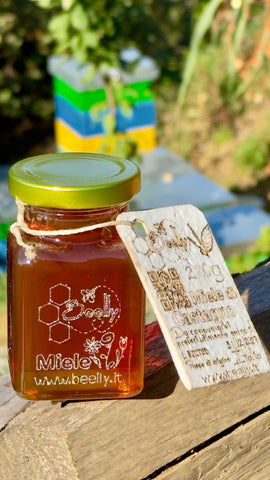


Tree Heather Honey 230 g – 2026 Micro-harvest
An early bloom. A difficult harvest.
Our Tree Heather Honey – 2026 Micro-harvest comes from the hills of Celle Ligure, during one of the first important moments of the beekeeping season. Pollen analysis identifies the sample as unifloral Heather honey, with Heather accounting for 62% of the nectar-producing species detected.
| Type | Unifloral Heather honey |
| Botanical origin | Heather – 62%* |
| Profile | Warm, caramel, aromatic and spiced |
| Origin | Celle Ligure · Liguria · Italy |
| Harvest | 2026 · micro-harvest |
| Annual production | 368 jars of 230 g |
*Percentage refers to the nectar-producing species detected in the pollen analysis of the sample tested.
Read the full 2026 Harvest sheet ↓
An early bloom, when everything is more difficult
Tree Heather blooms very early, between the end of winter and the beginning of spring, when the colonies have not yet reached their full season strength.
Shorter days and unstable weather can make it difficult to fully exploit this bloom. That is why obtaining a unifloral Heather honey is never a given.
One of the first great blooms of the year. One of the most difficult harvests to obtain.
A micro-harvest tied to the season
In the 2026 Micro-harvest, pollen analysis detects Heather at 62% of the nectar-producing species and identifies the sample as unifloral Heather honey.
We do not try to obtain an identical honey every year: we follow what the bloom, the weather, and the bees' work truly allow us to harvest.
A honey with a bold character
The 2026 Harvest is dark, crystallized and homogeneous, with a creamy consistency and fine crystals.
The profile is warm, caramel, aromatic and spiced. On the palate, it is sweet, moderately acidic, and has a slight bitter note.
The character of Ligurian Tree Heather
Celle Ligure · Liguria · Italy
Our bees forage on the Ligurian coastal hills, where Tree Heather grows alongside many other wild species. Indeed, alongside Heather, the analysis also detects pollen from willow, thyme, chestnut, laurel, and other local plants.
How to pair it
Its warm and slightly bitter character pairs well with bold flavors.
Cheeses: aged pecorino and goat cheeses, Parmigiano Reggiano, and blue cheeses.
Meat: roast or grilled pork, lamb, and intensely flavored dishes.
Salads: radicchio, walnuts, and aged cheeses, including in a vinaigrette.
Desserts: dark chocolate, walnuts, and chestnuts.
Drinks: black tea and spiced herbal teas.
Format
230 g glass jar.
2026 Micro-harvest – availability limited to annual production.
Full 2026 Harvest sheet
Pollen and organoleptic analysis performed by an independent laboratory on the sample tested.
| Denomination | Unifloral Heather honey |
| Heather | 62% of nectar-producing species detected |
| Physical state | Crystallized |
| Appearance | Homogeneous |
| Color | Dark |
| Olfactory intensity | Medium |
| Odor | Warm, caramel, aromatic and spiced |
| Aromatic intensity | Medium |
| Aroma | Warm, caramel and aromatic |
| Aromatic persistence | Medium |
| Taste | Normally sweet, moderately acidic |
| Bitter | Slightly perceptible |
| Consistency | Creamy |
| Crystals | Fine |
| Organoleptic defects | None perceptible |
The botanical and organoleptic values reported refer to the sample analyzed.
Laboratory analysis available upon request.
The full report for the analyzed sample can be requested by contacting Beelly.
Related Products
Da questa collezione
-
Beelly
Ligurian Chestnut Honey Small batch – Celle Ligure, Savona – 230 g | BeellyThe most bold character of our collections. Our Ligurian chestnut honey originates ... -
Beelly
Ligurian Wildflower Honey 230 g - I Primi Voli – 2026 harvestThe honey that opens the season.An early spring wildflower honey harvested on the hills of Cell... -
Beelly
Acacia Honey 230 g – 2026 HarvestThe most delicate part of spring.Clear, limpid, and naturally delicate, our Acacia Honey – 2026...